Durapower Strengthens Grid Stability and Advances Clean Energy
Integration of a 10 MW / 20 MWh Liquid-Cooled BESS at Banpu’s Jinhe 100 MW Fishery-Solar PV Project
Project Case Study | Banpu Carbon Neutral Energy Technology (Jinhu) Co., Ltd. | Huai’an, Jiangsu, China
Singapore, 5 November 2026
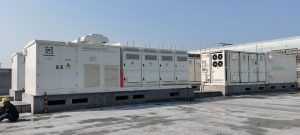
Site photo: Durapower-branded BESS units installed at the Jinhe project’s 220 kV substation.
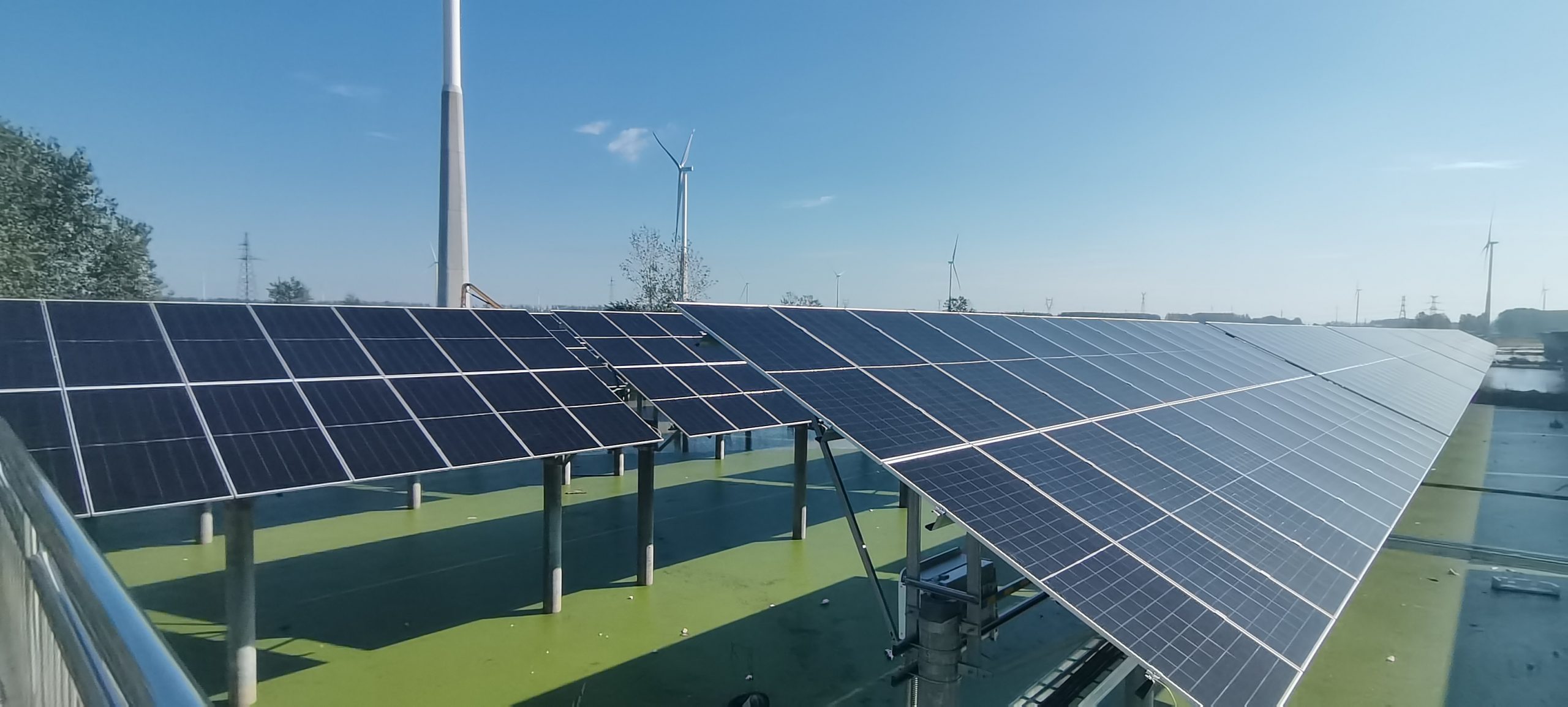
One would not expect to find a power plant of such scale in the water-rich plains of Jinhu County, Huai’an, Jiangsu Province, China. Across roughly 1,900 mu (about 127 hectares) of aquaculture ponds, Banpu Carbon Neutral Energy Technology (Jinhu) Co., Ltd. is building the Jinhe 100 MW PV Project: a concentrated “fishery-solar complementary” station in which photovoltaic arrays are mounted above the water while fish farming continues beneath — “power above, fish below.”
The station is planned for 100 MW of AC capacity (about 121 MWp on the DC side) across 44 generating units, with a new 220 kV substation stepping the energy up to the grid. Sitting alongside the substation is a 10 MW / 20 MWh, 0.5 C battery energy storage system (BESS), supplied and integrated by Durapower — the plant’s silent grid balancer.
01 The Project: Clean Energy over 1,900 Mu of Ponds
Built on existing aquaculture ponds, the Jinhe project generates solar power without sacrificing a single hectare of farmland. This dual-use model — 水上发电、水下养殖 (power on the water, fish below) — keeps the ponds producing food while the arrays above produce clean electricity.
The new 220 kV substation collects the output of the entire plant and provides a single, grid-compliant point of interconnection. Inside the substation, the 10 MW / 20 MWh storage system is configured for 0.5 C charge and discharge — a full charge or discharge in two hours.
Site photo: Fishery-Solar system at the Jinhe project.
02 Why Two Hours of Storage Matters
Two hours is not an arbitrary figure. Under Jiangsu’s market-based grid-connection policy for photovoltaic projects, new renewable plants must be supported by new-type storage with a duration of no less than two hours, at a power ratio of 10% or more. The province also sets the performance bar: capacity degradation below 20% over the operating period, AC-side efficiency above 85%, depth of discharge above 90%, and station availability above 90%.
Beyond compliance, the Durapower system is designed to be an active grid asset. It supports peak shaving and valley filling, primary frequency regulation, AGC and AVC dispatch, reactive power and voltage support, inertia support (including damping control and fast frequency response), emergency frequency regulation, one-click ramp, and short-circuit capacity enhancement — all remotely dispatchable by the system operator. The storage system does not just store energy; it helps stabilize the grid around it.
03 The Durapower Solution at a Glance
The solution is a fully integrated, containerised battery energy storage system (BESS) designed to store renewable energy and support grid stability. Its key specifications and features include:
- 10 MW / 20 MWh capacity: Delivers 10 MW of power with 20 MWh of energy storage, equivalent to two hours of discharge at rated power.
- Modular configuration: Comprises two parallel 5 MW / 10 MWh units, with 120% over-configuration and a reserved position for an additional 2.5 MW / 5 MWh unit.
- Integrated power conversion: Each unit features a 5,500 kVA converter-and-transformer cabin and two 5.015 MWh liquid-cooled battery cabins.
- Grid connection: Steps up the output voltage to 37 kV for connection to the 220 kV substation.
- Advanced battery and control systems: Uses lithium iron phosphate (LFP) battery cells, a three-tier battery management system (BMS), liquid-cooled thermal management and a station-level energy management system (EMS).
- Multi-layer fire protection: Incorporates multiple layers of fire safety measures to help protect the system.
- Factory-integrated delivery: Supplied as prefabricated, factory-tested units to support quality control and simplify on-site installation.
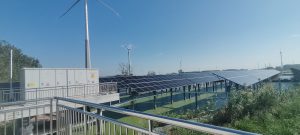
Durapower 5 MWh liquid-cooled battery cabin (product render).
04 Engineering Highlights: Built for Real-World Grid Performance
4.1 Liquid-Cooled Thermal Management
Every cabin is cooled by a liquid-cooling system designed through CFD thermal simulation, keeping cell temperature differences within ±3 °C inside a module and within 5 °C across a cluster — the key to long cycle life and consistent performance. The system features automatic coolant refilling, liquid-level alarms, and leak detection that can trip the system and alert maintenance teams before a small fault becomes a big one.
4.2 A BMS That Watches Every Cell
The three-tier battery management system (CMU at module level, BMU at cluster level, BAU at stack level) monitors every cell voltage and temperature, estimates SOC, SOE and SOH, and balances cells passively. Measurement accuracy is high — cell voltage within ±3 mV, temperature within ±1 °C, current sampled within 50 ms — and the BMS stores more than 90 days of local data, with an MTBF of more than 40,000 hours.
4.3 Grid-Responsive Power Conversion
The 1,500 V-class PCS integrates the converter and step-up transformer in a single cabin, with a maximum efficiency of 98% or more and total harmonic distortion below 3%. It responds to power dispatch in under 100 ms, transitions between charge and discharge in under 100 ms, and carries full low-voltage and high-voltage ride-through capability. Virtual synchronous generator (VSG) functionality gives the plant inertia-like behavior — damping control and fast frequency response that help a renewables-heavy grid stay stable.
4.4 Station-Level EMS
The energy management system coordinates all storage units with the PV plant and the grid dispatcher, executing AGC and AVC instructions, one-click ramp, and emergency frequency regulation, while generating daily, monthly, quarterly and annual operation reports for the operator.
05 Safety by Design
Safety is engineered at every layer. Each battery PACK is protected by a dedicated perfluorohexanone suppression nozzle, with a fixed automatic fire-suppression system guaranteed to deliver at least 7% extinguishing concentration. Smoke, heat, CO and H2 sensors watch the cabin 24/7, triggering ventilation interlocks and cluster-level DC disconnection. Explosion-proof ventilation (Ex d II CT4) exchanges the cabin air at least six times per hour under normal operation and up to 60 times per hour in emergency, and a rapid water-fire interface provides the final line of defense.
The container itself is IP55, IK10 and C3-corrosion rated, built with A-class non-combustible insulation, a 25-year design life and a non-walk-in layout that keeps personnel out of the hazard zone. UPS keeps control systems alive for at least 2 hours — and the fire system for at least 3 hours — in a blackout.
06 Durapower’s Commitment to Performance
Durapower backs the system with contractual performance commitments:
- High cycle life for 10 years operations
- Built to outlast the rest: ≥77% capacity after a full decade of heavy use
- High AC-side efficiency of ≥85% after 5 years
- Always-on availability: ≥96% uptime, 350+ days of power every year
- Only A-grade cells are accepted, with third-party sampling inspection per GB/T 36276-2023 before delivery — because in energy storage, what is measured is what can be trusted.
07 A Clean-Energy Partnership
The Jinhe project shows what the energy transition looks like on the ground: land that keeps farming, water that keeps producing, and a grid that gets stronger. By pairing a 100 MW fishery-solar plant with two hours of flexible, fast-responding storage, Banpu and Durapower have built an integrated renewable asset that is compliant, dispatchable and durable.
Durapower is a Singapore-headquartered lithium-ion battery and energy storage technology company, with its China subsidiary, Suzhou Xinzhong Energy Technology Co., Ltd., manufacturing battery modules and delivering the BESS solution. To learn how Durapower’s BESS solutions can power your next renewable project, contact our team.
About Durapower Group
Headquartered in Singapore, Durapower offers closed-loop, end-to-end energy storage solutions for the electric mobility and renewable energy applications including on and off-road Electric, Hybrid and Plug-in Hybrid Electric Vehicles, electric marine vessel and stationary energy storage solutions. Since 2009, Durapower has been a leading innovator of Lithium-Ion cell technology, focusing on the research and development of battery materials, battery cell manufacturing and system integration. With a global presence spanning 25 countries and 70 cities, including European Countries, China, India and Southeast Asia. Durapower Group strives to make scalable, sustainable batteries that support the circular economy, empowering lives and transforming the future towards a carbon-neutral economy. Durapower does not manufacture, sell or distribute batteries intended for use in relation to household or consumer electronics.